
Predictable Demand for Agencies: Build Repeatable Results
Table of Contents
- Why Predictable Demand Matters for Agencies
- The Founder Dependency Problem: Revenue That Stops When You Do
- Building Agency Lead Generation Systems That Actually Scale
- Productised Service Models for Agencies: Your Path to Repeatable Revenue
- Scaling an Agency Without Founder Involvement: The Systems Framework
- Measuring What Matters: KPIs for Predictable Demand
- From Referral-Based to System-Based Growth
- Conclusion: The Business You Actually Want
- Frequently Asked Questions
Last Updated: September 2, 2026
Why Predictable Demand Matters for Agencies
Predictable demand agencies stop the feast-or-famine cycle. Most service-based agencies operate on referrals and relationships. Revenue spikes when a client recommends you. Revenue dries up when they don't. That's not a business, that's a job you haven't optimised yet.
The difference between an agency that survives and one that scales comes down to one thing: can you generate consistent leads without relying on founder relationships? If the answer is no, you're not running an agency. You're running yourself into the ground.
Predictable demand means you have a system. Prospects enter at the top. Your team converts them. Revenue flows in on a schedule you can forecast. No surprises. No panic. No founder scrambling to save the month.
According to HubSpot's 2026 State of Marketing Report, 73% of high-performing marketing teams attribute their success to structured lead generation systems rather than referral-dependent models. The difference shows up in revenue stability, team morale, and, most importantly, the founder's ability to step back.
This is where most agency owners get stuck. They've built something valuable. But they haven't built something that works without them. That's the real problem.
The Founder Dependency Problem: Revenue That Stops When You Do
Here's the diagnostic question: can your business deliver its promise without you acting as the glue?
Most agencies can't. The founder is the rainmaker. The founder manages key client relationships. The founder knows how to pitch. The founder closes deals. Remove the founder, and the whole thing collapses.
This isn't a personal failing. It's a structural problem. You've built a service delivery business, not a scalable agency. There's a difference.
Founder dependency kills growth. It kills freedom. It kills valuation. If your business depends on you showing up, investors won't touch it. Buyers won't pay for it. Your team can't grow because you're the bottleneck.
The cost is hidden but real. You can't take holidays. You can't scale without burning out. You can't hire senior talent because there's nowhere for them to go, you're already in every important decision. You can't build repeatable processes because everything revolves around how you do it.
Agencies that have solved this problem think differently. They've stopped asking "How do I close more deals?" and started asking "How do I build a system that closes deals without me?"
That shift changes everything. It moves you from trading time for money to building predictable demand and repeatable results for marketing agencies that run on process, not personality.
Building Agency Lead Generation Systems That Actually Scale
An agency lead generation system is the infrastructure that turns prospects into clients consistently. Not occasionally. Consistently.
Most agencies have no system. They have a Rolodex. They have a LinkedIn profile. They have a website that sits there. That's not a system, that's hope with a domain name.
A real system has stages. Prospects know where they are in your pipeline. Your team knows what happens next. You can forecast revenue because you know how many leads convert at each stage.

The system starts with clarity on who you serve. Not "marketing agencies" or "service businesses." Specific. Niche. A clear avatar. If you try to serve everyone, you'll struggle to serve anyone.
From there, you need a lead source. This is where most agencies fail. They rely on inbound, waiting for prospects to find them. Inbound is slow. It's unpredictable. It takes months to build momentum.
Outbound is faster. You reach out to prospects directly. You qualify them before they waste your time. You control the volume. This is how you build predictable demand. You decide how many conversations you want to have each week, then you build the system to have them.
The system includes messaging. What do you say when you reach out? What problem do you solve? What makes you different? Most agencies have vague positioning. "We help businesses grow." That doesn't work. You need to articulate the specific transformation you deliver.
Then comes nurturing. Not every prospect is ready to buy. Some are interested but not convinced. Some are convinced but not ready to invest. Your system keeps them warm. You send relevant content. You stay top of mind. When they're ready, they come to you.
Finally, conversion. How do you move a qualified prospect to a client? What's your pitch process? How long does it take? What's your close rate? If you don't know these numbers, you don't have a system, you have chaos.
The agencies that build predictable demand and repeatable results for marketing agencies measure every stage. They know their conversion rates. They know their average deal size. They know their sales cycle. With that data, they can forecast. And forecasting is how you stop living in fear.
Productised Service Models for Agencies: Your Path to Repeatable Revenue
A productised service is a repeatable offer with a fixed scope, fixed price, and fixed timeline. It's the opposite of custom work.
Most agencies do custom work. Every project is different. Every client has unique needs. Every scope is negotiated. This creates chaos. It kills margins. It makes scaling impossible.
Productisation changes that. You define what you deliver. You define how much it costs. You define when it's done. The client either buys it or doesn't.
This sounds restrictive. It's actually liberating. Here's why: productised services scale. You can systematise them. You can train team members to deliver them. You can deliver them consistently without the founder's involvement.
The Level Up Method™ starts here. Productise your expertise. Turn what you know into a repeatable offer. Package it. Price it. Sell it.
A productised offer for an agency might look like this:
- "Brand Positioning Sprint: 6 weeks, fixed scope, fixed price"
- "Lead Generation System Audit: 2 weeks, includes report and recommendations"
- "Sales Messaging Workshop: 1 day, team of up to 10 people"
Each one is defined. Each one is repeatable. Each one can be delivered by someone other than you.
The benefit is immediate. Your revenue becomes more predictable. Your margins improve because you're not negotiating every project. Your team can deliver consistently because they know exactly what's expected.
Most agencies resist this. They say their work is too custom. Every client is different. You can't package it.
That's true for 20% of what you do. The other 80%? That's repeatable. That's where your volume is. That's where your scale lives.
Scaling an Agency Without Founder Involvement: The Systems Framework
This is where most agency owners get it wrong. They think scaling means hiring more people. It actually means building systems that work without you.
The Systems Framework has three layers: processes, people, and performance.
Processes: These are your repeatable workflows. How do you qualify a lead? How do you onboard a client? How do you deliver your service? How do you handle support? Every important activity needs a documented process. Not a vague guide. A step-by-step process that someone new can follow.
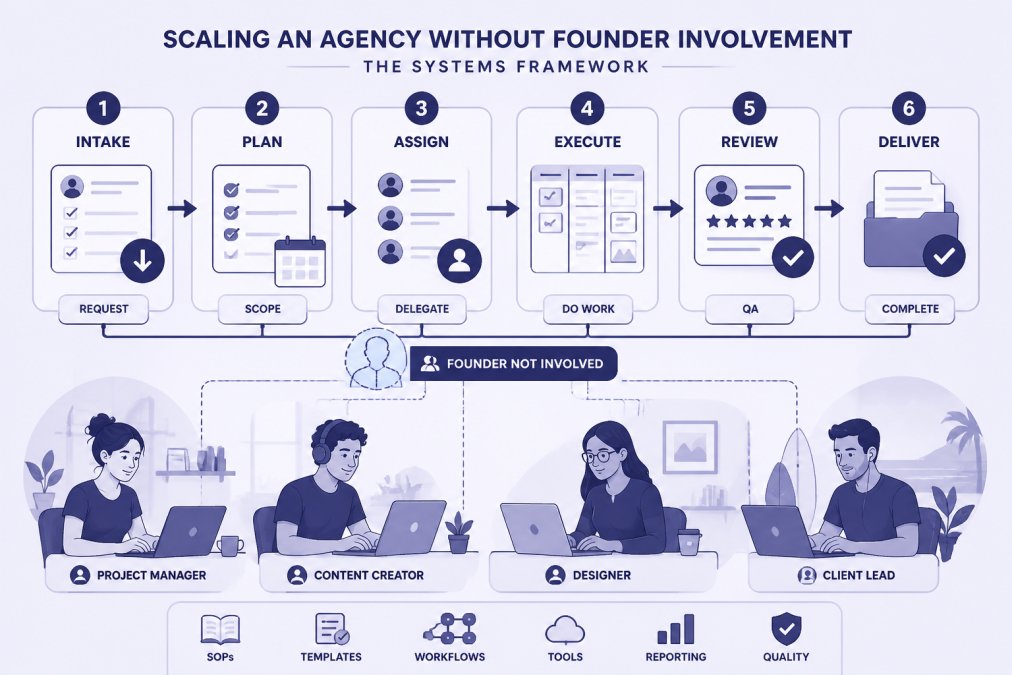
People: These are your team members executing the processes. You hire them. You train them on your systems. You hold them accountable to the standards you've set. The founder is no longer doing the work. The founder is managing the people who do the work.
Performance: These are your metrics. You measure what matters. Lead volume. Conversion rates. Client satisfaction. Team capacity. Revenue per team member. If you're not measuring, you're not managing.
Most agencies skip the performance layer. They assume things are working because they feel busy. That's not data. That's just exhaustion.
The agencies that scale without founder involvement are obsessive about measurement. They know their numbers. They can see where the bottlenecks are. They can see where to invest next.
Here's the diagnostic: if your founder disappeared for three months, would the agency still function? Would leads still come in? Would clients still get served? Would revenue still flow?
If the answer is no, you don't have a scalable agency. You have a founder-dependent business. That's not an asset. That's a liability.
Measuring What Matters: KPIs for Predictable Demand
You can't manage what you don't measure. Most agencies measure the wrong things.
They measure hours worked. They measure projects completed. They measure client satisfaction. These matter, but they don't tell you whether you have predictable demand.
The KPIs that matter are:
Lead Volume: How many qualified leads enter your pipeline each month? This is your input. If it's inconsistent, everything else is inconsistent.
Conversion Rate: What percentage of leads become clients? If you have 100 leads and close 10, your conversion rate is 10%. This number tells you whether your messaging and positioning are working.
Sales Cycle: How long does it take from first conversation to signed contract? If it's three months, you need to plan accordingly. If it varies wildly, your process isn't clear.
Average Deal Size: What's the average revenue per client? This tells you whether you're attracting the right calibre of work.
Client Lifetime Value: How much does an average client spend with you over the relationship? This tells you whether your retention is working.
Team Capacity: How many clients can your team handle right now? This tells you whether you can take on more work or whether you need to hire.
These six metrics tell you everything you need to know about the health of your agency. If your lead volume is low, you have a demand problem. If your conversion rate is low, you have a positioning problem. If your sales cycle is long, you have a process problem.
Most agencies don't track these. They're flying blind. They don't know why revenue fluctuates. They don't know where to invest. They don't know whether they're improving or declining.
Start measuring. Get clarity. Then you can actually manage the business instead of just surviving in it.
From Referral-Based to System-Based Growth
Referral-based growth feels good. A happy client recommends you. New business arrives. No effort required.
The problem: it's not reliable. It's not scalable. It's not repeatable. You're dependent on your clients' willingness to refer you, their network size, and their motivation to help. That's three variables you don't control.
System-based growth is different. You control the input. You decide how many leads you want to generate. You build the system to generate them. You execute the system consistently.
This requires a shift in mindset. Referral-based agencies think of growth as something that happens to them. System-based agencies think of growth as something they build.
The transition is uncomfortable. You have to invest in lead generation before you see results. You have to hire people to execute the system. You have to measure and refine. It takes discipline.
But the payoff is real. Your revenue becomes predictable. Your growth becomes repeatable. Your business becomes valuable because it doesn't depend on your personal relationships.
According to McKinsey's research on B2B sales acceleration, companies that transition from referral-based to system-based lead generation see revenue growth stabilise within 12-18 months, with 40% improvement in forecast accuracy.
The agencies that make this transition are the ones that survive and scale. The ones that don't are the ones that plateau and eventually decline.
Conclusion: The Business You Actually Want
The business you actually want doesn't depend on you showing up every day.
It has predictable demand. Leads come in consistently. Your team converts them. Revenue flows. You can forecast next quarter's revenue with confidence.
It has repeatable processes. New team members can deliver your service because it's documented and systemised. The founder isn't the bottleneck.
It has measurable results. You know your numbers. You know where you're winning. You know where you need to improve. You manage by data, not intuition.
This is what Level Up Business Mastery helps expert-led founders build. We've worked with over 500 founders to move from founder-dependent to system-dependent growth (peer-reviewed research). They've generated over $45M in combined revenue by productising their expertise, installing scalable systems, and removing themselves as the glue.
The Level Up Method™ starts with Productise. You turn what you know into a repeatable offer. Then Systemise. You build the processes that deliver it without you. Then Scale. You grow the business using those systems.
If you're ready to stop trading time for money and build a business that works without you, the 12 Week Launchpad for Startups is designed to get you moving fast, or explore the Accelerator Membership if you're an established founder ready to systemise and scale. Both are built on the Level Up Method™ to help you create predictable demand and repeatable results for marketing agencies.
The question isn't whether you can build this. You can. The question is whether you're willing to do the work to get there.
Frequently Asked Questions
What's the difference between founder-led sales and a systemised lead generation model?
Founder-led sales relies on your personal relationships, network, and selling ability, the business stops growing when you stop selling. A systemised model builds repeatable processes: defined target audiences, consistent outreach sequences, qualification criteria, and follow-up workflows that run without you. The shift means your agency generates predictable demand through structure, not personality. This is the foundation of scaling an agency without founder involvement.
How do productised service models help agencies achieve repeatable results?
Productised services turn custom delivery into standardised packages with clear scope, pricing, and outcomes. Instead of custom quotes for every prospect, you offer fixed offerings (e.g., 'Brand Audit Package' or '90-Day Growth Sprint'). This reduces sales friction, speeds up closing, makes delivery repeatable, and lets you build predictable demand because prospects know exactly what they're buying. It also frees your team to focus on consistent execution rather than custom problem-solving.
What metrics should I track to know if my demand generation system is working?
Track: (1) Monthly qualified leads generated (your pipeline input), (2) Lead-to-client conversion rate, (3) Average revenue per client, (4) Sales cycle length, (5) Customer acquisition cost, (6) Revenue per month (consistency, not spikes). The goal is stability, flat or growing revenue month-to-month without feast-famine cycles. If your metrics are volatile or dependent on one revenue source, your demand system isn't working yet.
Can your business deliver its promise without you acting as the glue?
This is the diagnostic question every agency founder must answer honestly. If clients only trust you, if sales stop without you, if team members can't make decisions, you don't have a business, you have a job. Predictable demand systems exist to answer 'yes' to this question. They replace founder dependency with documented processes, clear roles, and systems that work whether you're in the room or not. That's what makes repeatable results possible.
This article was written using GrandRanker